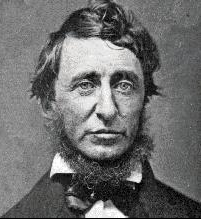
Henry David Thoreau was a visionary, a seer, an oracle. Not merely one of our most accomplished writers and naturalists, I believe he foresaw some dimensions of the looming conflicts about the land and the way human beings use it - and how we might live together on it.
It became popular in the early 2000's to revisit Thoreau and find the man and his work incomplete, flawed after all. Despite our having been inoculated with Thoreau in literature courses during our secondary and post-secondary educations, the early years of this century seemed to give permission to various writers to criticize Thoreau in new ways. (Since he had been dead so long, and maybe in some cases because even their literature professors were also now dead...perhaps they felt somehow emboldened?)
Yet other scholars have unearthed facts that these critics had overlooked.
Donovan Hohn writes in the New Republic: (
https://newrepublic.com/article/123162/everybody-hates-henry-david-thoreau)
“'One misperception that has persisted is that he was a hermit who cared little for others',
says Elizabeth Witherell,
who has spent a few decades editing a critical edition of Thoreau’s
collected works. “He was active in circulating petitions for neighbors
in need. He was attentive to what was going on in the community. He was
involved in the Underground Railroad.” He quit his first teaching job,
in protest, because he was expected to administer corporal punishment,
and struggled to find a new one. He loved watermelons, and threw an
annual watermelon party for his friends, of whom he had plenty. Children
were especially fond of him. Sophia and Thoreau’s mother were founding
members of the Concord Women’s Anti-Slavery Society, and Thoreau invited
them to convene at least one meeting that we know of at his cabin in
the woods, to celebrate the anniversary of the emancipation of slaves in
the Indies. As for family, he lived most of his life in his parents’
boarding house, paying rent and helping out as a handyman. He was very
handy. He could dance, and play music. He wrote lovingly about his
father, mother, and siblings in his journals, and they wrote lovingly
about him, and he was so devastated by his brother’s death that he
developed symptoms of tetanus in sympathy."
Rebecca Solnit writes in Orion magazine: (
https://orionmagazine.org/article/the-thoreau-problem/)
"This compartmentalizing of Thoreau is a microcosm of a larger partition
in American thought, a fence built in the belief that places in the
imagination can be contained. Those who deny that nature and culture,
landscape and politics, the city and the country are inextricably
interfused have undermined the connections for all of us (so few have
been able to find Thoreau’s short, direct route between them since).
This makes politics dreary and landscape trivial, a vacation site. It
banishes certain thoughts, including the thought that much of what the
environmental movement dubbed wilderness was or is indigenous homeland —
a very social and political space indeed, then and now — and especially
the thought that Thoreau in jail must have contemplated the following
day’s huckleberry party, and Thoreau among the huckleberries must have
ruminated on his stay in jail."
Travel is another topic with references from Thoreau, and his words when much abbreviated over the past 170 years can be misleading. A famous line of Thoreau's is often quoted as: “I have traveled a good deal in Concord", but this leaves out the remainder of his thought. The full sentence indeed reads: “I have traveled a good deal in Concord; and
everywhere, in shops, and offices, and fields, the inhabitants have
appeared to me to be doing penance in a thousand remarkable ways.” Thoreau took care to head in the other direction - and most of the time, on foot.
He had his detractors then, as now - and I'm betting that didn't bother him very much. So I return to him and his writings, over and over - a singular character on the American scene, when it was full of ferment and change - maybe not all that different from right now?
Other Resources:
https://matadornetwork.com/bnt/what-henry-david-thoreau-taught-me-about-travel/